
|
Our thoughts and prayers are
with Marian and Al's family and friends.
|
|
Marian McCargo Bell
1931-2004 |
|
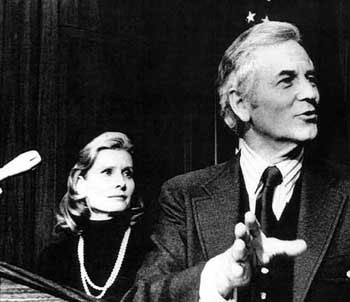
Marian McCargo Bell, a television and movie actress and the wife of former Rep. Alphonzo Bell Jr., has died. She was 72. Bell died Wednesday of pancreatic cancer at an assisted living facility in Santa Monica. As Marian McCargo, Bell appeared in "The Undefeated," a 1969 western starring John Wayne and Rock Hudson. She also had roles in "Dead Heat on a Merry Go Round" (1966), "Doctor's Wives" (1971), and "Buona Sera, Mrs. Campbell" (1969). Among her numerous television credits are "Perry Mason," "Hawaii 5-0," "Hogan's Heroes," "Voyage to the Bottom of the Sea" and "Falcon Crest." Bell, who was born in Pittsburgh, attended West Hills College in Boston, where she met her first husband, Richard Cantrell Moses, who later became an advertising executive in Los Angeles. A former tennis champion and Wightman Cup winner, Bell defeated Mo Connelly at Forest Hills, N.Y., in 1950. Decades later, she won California's State Senior Tennis Championship in doubles. When she and Bell (R-Beverly Hills) married in 1970, she had four sons by her previous marriage and he was a widower with three sons. She became an active political wife who campaigned for her husband, including during his unsuccessful bid for the U.S. Senate in 1976. She is survived by her husband, sons Rick, Graham, Harry and Billy Moses, and Matt, Bob and Tony Bell, all of Los Angeles; her brother, Grant McCargo of Sewickley, Pa., and 18 grandchildren. A memorial service will be held at 2 p.m. Thursday at Forest Lawn, Glendale. Instead of flowers, the family requests that donations be made to the Juvenile Diabetes Research Foundation, 1111 S. Arroyo Parkway, Suite 400, Pasadena, CA 91105. |
|
Alphonzo Bell Jr.
1914-2004 |
| Alphonzo Bell Jr., who represented Los Angeles' influential Westside
in Congress for eight terms and was a scion of the pioneering ranching,
oil and development family that gave its name to the Southern California
communities of Bell, Bell Gardens and Bel-Air, has died. He was 89.
Bell died Sunday at St. John's Hospital in Santa Monica of complications of pneumonia. The patrician politician's death came just 18 days after that of his wife of 34 years, actress and tennis champion Marian McCargo Bell. In Congress, Bell, a multimillionaire Republican, became known as mildly hawkish on foreign policy -- he backed the Vietnam War through three presidential administrations -- but often liberal on domestic issues that included open housing laws and other civil rights legislation. Some called Bell a political conservative, others a moderate. A Ralph Nader study on Bell's voting record in 1972 said: "It's hard to say exactly what he is. He leans in many areas, especially those concerning economic regulation, toward the conservatives. When it comes to the people issues, especially those concerning the downtrodden in American society, Bell is a liberal." The congressman described himself as "middle-ground" and said he voted according to principle and an issue's merits rather than political expediency. A moderate, he told a Times columnist in 1970, has to study harder. "The extremist at either end doesn't have to do most of the work or most of the thinking -- he knows what he's for and against beforehand. A moderate has to decide each question on its own merits." As a ranking member of the House committees on Science and Astronautics and on Education and Labor, he earned bipartisan approval for his work on such diverse bills as the Older Americans Act, the Elementary and Secondary Education Act, the Housing and Urban Development Act of 1968 and laws improving labor standards, workers' safety, veterans' benefits and environmental protection programs. He helped create a public park in the Santa Monica Mountains and open San Onofre beaches to the public. From 1950 to 1977, Bell represented a vast congressional district -- the 28th and, after redistricting, the 27th -- running along the coast from Malibu to the Palos Verdes Peninsula and encompassing all or part of Santa Monica, Pacific Palisades, Brentwood, Bel-Air and West L.A. Then considered a Republican stronghold, the district nevertheless had only 40% to 49% GOP voter registration, and bipartisan approval was essential. Wealthy, handsome and mild-mannered, Bell had no trouble appealing to voters in both parties. In 1964, he won reelection with the largest margin of any Republican congressman that year, and in 1966 he won by the largest plurality of any congressman of either party. He was so well-liked that one of his campaign aides once complained about the problems of raising Bell's visibility outside his own district, saying: "As a political figure without a breath of scandal, he never got much in the newspapers." Bell was unable, however, to transfer his popularity into winning higher office. He tried twice -- with an effort to unseat incumbent Sam Yorty in the Los Angeles mayoral race in 1969 and, in 1976, vying for a U.S. Senate seat held by Democrat John V. Tunney. Yorty retained his office, and Tunney fell to S.I. Hayakawa, who defeated Bell in the Republican primary. The mayoral race illustrated Bell's independence and determination to do what he believed in even though it could harm him politically. After he lost the primary, he actively campaigned for its winner, Democrat Tom Bradley. Although Bradley lost that general election, he did defeat Yorty in 1973 to become the city's first black mayor; he went on to serve a record four terms. Bell had long opposed Yorty, claiming he was "temperamentally unsuited" to govern Los Angeles and that his constant bickering with Washington had prevented the city from getting federal funds. Bell said Yorty's racial campaign against Bradley, along with earlier smear tactics against other opponents, filled him with revulsion. But Bell's support of Bradley in the nonpartisan race so irked some conservative Republican constituents, such as fellow oilman and Yorty backer Henry Salvatori, that Republican attorney John LaFollette was put forth to run for Bell's congressional seat in 1970. Bell prevailed and remained in Congress. Bell entered politics through Republican Party positions. He served as chairman of the Republican Central Committee of Los Angeles County, chairman of the Republican State Central Committee of California and as a member of the Republican National Committee. The politician was the grandson of James George Bell, who established Bell Station ranch (now the site of the city of Bell), in the Santa Fe Springs area in 1875, and went on to find oil. The congressman's great-uncle, Ed Hollenbeck, had arrived in the 1850s, founded the First National Bank, created a public transportation system and developed eastern portions of Los Angeles County. Alphonzo Bell Sr., the congressman's father, used initial oil profits to develop tony Westside communities, including parts of Westwood, Beverly Hills, Pacific Palisades and Bel-Air, which lured many of the elite of Hollywood and other wealthy residents. He also established the Bell Petroleum Co. and helped found Occidental College, where his son earned a degree in political science. After serving in the Army Air Forces during World War II, the younger Bell joined the family oil company and served as president from 1947 until 1959. Also a rancher and cattleman, Bell sold the oil company in 1975. Once divorced and twice widowed, Bell is survived by a daughter, Fonza; eight sons, Stephen, Matthew, Robert, Anthony, Richard, Graham, Harry and Billy; and 19 grandchildren. Services are scheduled for 11:30 a.m. Friday at Forest Lawn Glendale. The family has asked that any memorial donations be made to Childrens Hospital Los Angeles Diabetic Research, 4650 Sunset Blvd., Los Angeles, CA 90027. |